Get the back side of a nylon fabric wrong and the whole order can blow up. You eat the hidden cost, reject the lot, and watch your launch window close.
Here's the catch: "single-sided" and "double-sided" don't mean the same thing at every factory. Some suppliers blur the line with printing or coating, so you end up weighing a true knit against a coated substrate that only looks the part.
Read this and you'll learn to spec by what actually matters — then hold every supplier to that same yardstick.
The Sourcing Dilemma: 4 Pain Points B2B Buyers Hit
Nylon sourcing feels straightforward, right up until your first production order stalls. Before a single meter ships, most buyers have already lost time and margin to the same four problems.
1. The "single/double-sided" label means different things per supplier. One mill calls a single jersey "double-sided" because both faces look clean. Another reserves the term for a true interlock. You can't compare quotes until you pin down the definition.
2. Choosing the wrong face ruins print alignment and handfeel. A print that lands clean on the technical face may blur on the back. If your garment shows both sides, the wrong pick ships as rejects.
3. GSM gets guessed from photos, not measured. Buyers eyeball the weight, then the real grammage shows up off-spec. Cost, dye lots, and lead time all shift at once.
4. Finishing and MOQ fall out of sync and block your launch window. A bonding or print process needs a longer run than your MOQ allows. The line stops while you renegotiate, and the season's gone.
All four trace back to one habit: buying on labels instead of on quantified specs. The sections below give you the language and the thresholds to break it, mapped to our underwear collections: Bra & Bralette, Women's Undie, Sexy Lingerie, and Shapewear.
Knit Construction: Jersey vs Interlock, Not a Coating
No part of nylon sourcing gets mangled more than this. "Single-sided" and "double-sided" describe weft-knit structure here — not a print method, and not a coating.
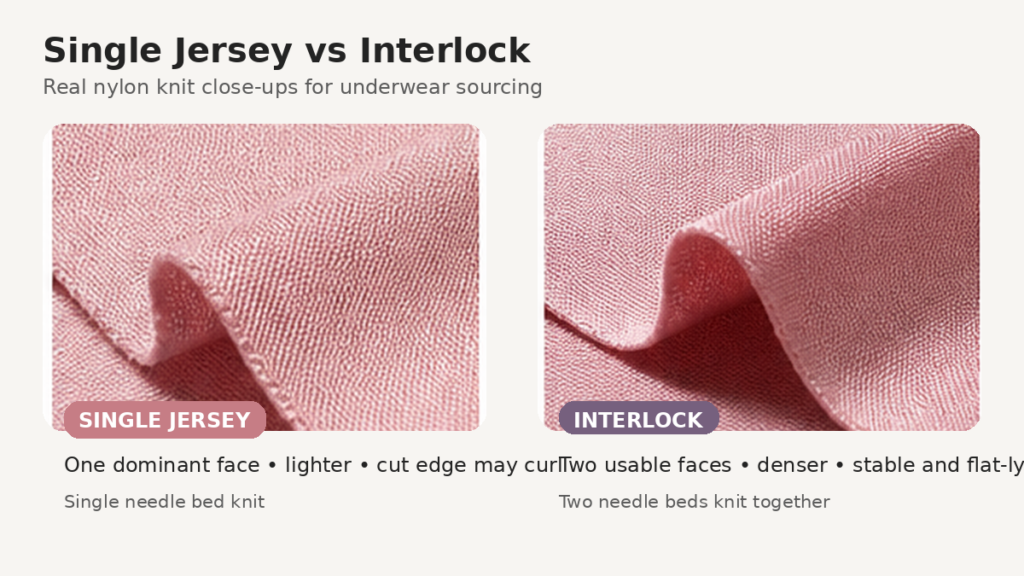
A single-sided nylon fabric is a weft-knit single jersey. It's made on a single needle bed. It's lighter, it curls at the cut edges, and it has one clearly dominant face.
A double-sided nylon fabric is a weft-knit interlock. Two needle beds knit together, which makes it stable, flat-lying, and usable on both faces.
Don't confuse this with "double-sided printing" or "double-sided coating." Some suppliers push a woven base with a TPU coating and call it "double-sided nylon." That's a laminate, not an interlock knit, and it behaves nothing like a real double-faced knit.
Before you ask for a quote, say which meaning you intend. If a mill answers "double-sided" without qualifying it, ask whether they mean interlock construction or a coated substrate. Need the construction explained in plain terms? See our knit construction guide or the Jelly Bra vs dot-glued bra QC guide.
Face & Back: How the Two Sides Differ
On a single jersey, the face and back aren't interchangeable. The front (technical face) carries the saleable look. The back is the loop side and usually stays hidden.
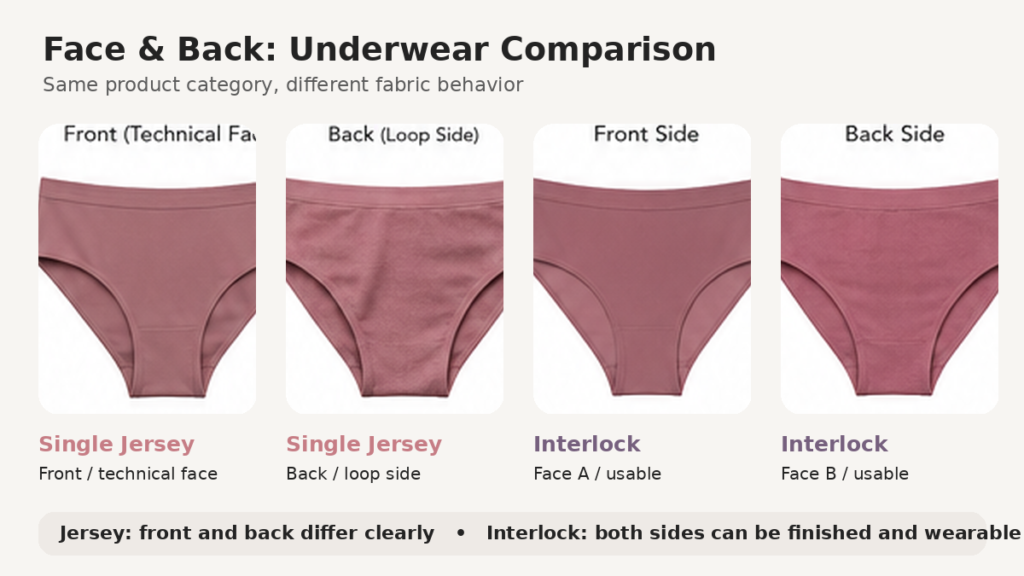
On an interlock, both sides are finished and wearable. You can flip the garment, show either face, or run a two-tone effect without adding a lining. Reversible nylon styles are sourced as double-sided interlock — both faces are finished and ready to show.
Reversible or lining-free designs? Double-sided is the structural answer. A print-forward layer that hides its back? Single-sided is enough, and cheaper.
This distinction drives everything downstream: print placement, lining cost, returns risk. Spec it early so the factory can't slip a single jersey in where an interlock was implied. The two-face option shows up across our Bra & Bralette, Sexy Lingerie, and Shapewear lines.
Weight & GSM: Matching Fabric to Garment
GSM is grams per square meter. It's the one number that decides drape, opacity, and cost — and it belongs on your purchase order, not in the mill's default settings.
As a planning reference, typical published ranges put weft-knit single-sided nylon around 150–300 g/m² (industry reference; confirm against your mill spec). Our double-sided interlock runs at 170 g/m² — a GOLDEN METRO confirmed spec, not an estimate. Standard knitting width runs about 150 cm (industry reference); match it to your lay plan. Treat the single-sided range and width as industry ballparks; lock your own target, tolerance, and width on the PO.
Always state GSM plus tolerance on the PO. Write the exact target, e.g. "GSM 220 ±5%" as an example tolerance, so the mill can't quietly swap in a different weight.
Lighter single jersey suits linings and lightweight layers. Denser interlock suits garments that need structure and coverage. Match the weight to the body zone, not to habit.
Planning a lingerie or shapewear program? The GSM you lock to each body zone drives both handfeel and per-unit cost, so treat it as a written spec, not a catalog default.
For the exact spec template we use, open our customization page.
Stretch & Recovery: 4-Way Performance That Holds Shape
Nylon on its own has modest stretch. In intimates and shapewear it's normally blended with spandex to deliver true 4-way stretch that recovers after repeat pulls. Most intimate-grade nylon knits run about 75–85% nylon with 15–25% spandex (industry reference range); the exact ratio sets how the fabric recovers.
Recovery is the number that matters. A bralette stretched hundreds of times has to return to shape, or the product fails in its first month of wear. Single jersey and interlock both take spandex blends, but the interlock's stable base holds the recovered shape more consistently across the panel.
Exact stretch percentage and recovery rate depend on the spandex ratio and the knit. Put those numbers in the PO in writing, tested against your standard, before bulk knitting starts.
For shapewear programs, recovery tolerance isn't negotiable. See our Shapewear collection for program-level notes.
Breathability & Handfeel
Single jersey reads lighter, softer, more fluid in the drape. It ventilates better because the structure is open and thin.
Interlock reads denser, with more support and better opacity. It covers and holds without a second layer — which is why it dominates structured intimates.
Handfeel is subjective, so back every claim with a number. State air permeability, stiffness, or a comparable metric, and we'll test against the standard you specify instead of asserting a vague "soft."
Claims without a spec are exactly how buyers get burned. Quantify, then trust the data. For structured intimate programs, the denser option is covered in our Bra & Bralette and Sexy Lingerie collections.
Application Matching: Bra, Undie, Lingerie & Shapewear
The right pick follows the garment, not the trend. As an underwear factory, we match the knit to each product line below.
- Bra & Bralette — mostly double-sided interlock for balanced handfeel, recovery, and a clean inside finish. MOQ is 3000 pcs/color. See Jelly Bra, Plunge Bra, Bralette, and Nursing & Maternity Bra.
- Women's Undie — single jersey for lightweight, breathable everyday styles; double-sided interlock where support or a premium handfeel matters. Laser-cut (hot-cut) seamless underwear and bras are best built on double-sided interlock — its cut edge doesn't curl, so the sealed edge stays clean without a lingerie stitch. MOQ is 3000 pcs/color. See Laser Cut Underwear and Period Panty.
- Sexy Lingerie — double-sided, high-stretch interlock for body-hugging styles. MOQ is 1000 pcs/color.
- Shapewear — double-sided, high-stretch interlock for shaping and compression. MOQ is 1000 pcs/color.
A simple threshold framework:
- Need high weight plus shaping → double-sided.
- Need lightweight, breathable everyday wear → single-sided.
- Need reversible or two-tone faces → double-sided.
- Need lowest cost at volume → single-sided.
Browse our collections to match fabric to program: Bra & Bralette, Women's Undie, Sexy Lingerie, Shapewear.
Cost & MOQ: Real Numbers for B2B Orders
Here are the minimum order quantities we actually hold, stated plainly so you can plan a collection:
- Underwear and bras: 3000 pcs per color.
- Lingerie and shapewear (including erotic): 1000 pcs per color.
MOQ is counted per color, not per style. A three-color bra run is three separate minimums, so plan your color matrix before the order opens.
Cost comes down to three things: yarn price, machine time, and yield. Interlock uses more yarn and two needle beds, so it generally runs higher than single jersey at equal GSM.
We knit in-house rather than buying through a trading middleman, so the cost you see tracks yarn, machine time, and yield directly — no reseller markup stacked on top of the interlock premium. With a low MOQ of 1000 pcs/color for shapewear and lingerie lines, we support smaller launch runs without that middleman overhead.
Lower GSM single jersey is your lever when the program must hit a price point at volume. Trade the two-face versatility for the saving only where the design allows it.
For private-label and OEM planning, our customization page lays out how MOQ scales with development steps.
Printing, Bonding & Finishing Compatibility
Printing usually lands on the single jersey technical face. That's where registration and color are most reliable, and where your artwork should be set up.
Double-sided fabric can be printed on both faces, but expect higher cost and tighter alignment. Each face has to be trapped and registered, which doubles the setup risk on a reversible style.
Bonding, lamination, and heat-press all depend on temperature zones. Nylon and spandex have upper limits before the panel distorts, so the finishing house has to match the press profile to the knit.
Reminder: printing and finishing are separate from the knit structure. A double-sided print is still a single interlock base. Keep the two conversations separate when you brief the supplier.
Our customization page captures finish, temperature, and tolerance in one place, so the mill can't quietly swap the process.
Side-by-Side Comparison Table
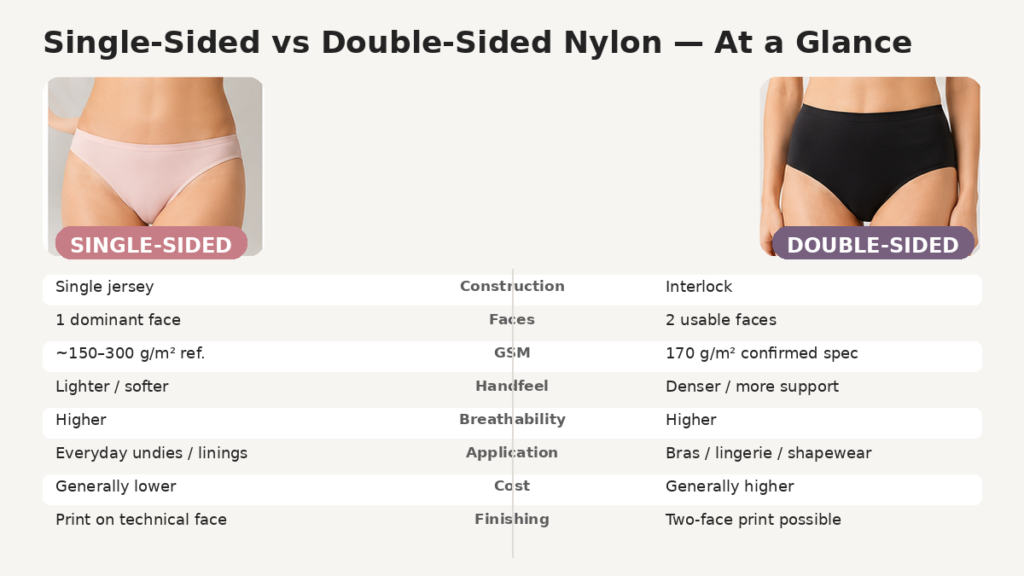
Use the table below as your single reference for single-sided vs double-sided nylon fabric across all eight sourcing dimensions. The MOQ figures are our committed minimums, not estimates.
| Dimension | Single-Sided | Double-Sided |
|---|---|---|
| Knit Construction | Weft-knit single jersey (single needle bed) | Weft-knit interlock (two needle beds) |
| Face & Back | One dominant face, back hidden | Two usable faces, reversible |
| GSM | ~150–300 g/m² (ref) | 170 g/m² (GOLDEN METRO confirmed) |
| Stretch & Recovery | 4-way with spandex; recovery to spec | 4-way with spandex; stable recovery to spec |
| Breathability & Handfeel | Lighter, softer, more breathable | Denser, more support, better opacity |
| Application | Everyday undies, lightweight bra linings | Bras, lingerie, shapewear, reversible styles |
| Cost & MOQ | Lower cost; 3000 pcs/color (innerwear) | Higher cost; 1000 pcs/color (shapewear) |
| Finishing | Print on face; simpler bonding | Two-face print; tighter temp control |
That table is the fastest way to brief a new buyer or a factory. For the right product line, browse Bra & Bralette, Women's Undie, Sexy Lingerie, or Shapewear.
Buyer's Decision Checklist & Next Step
Run this six-step check before you open the PO. It kills the four pains at the source.
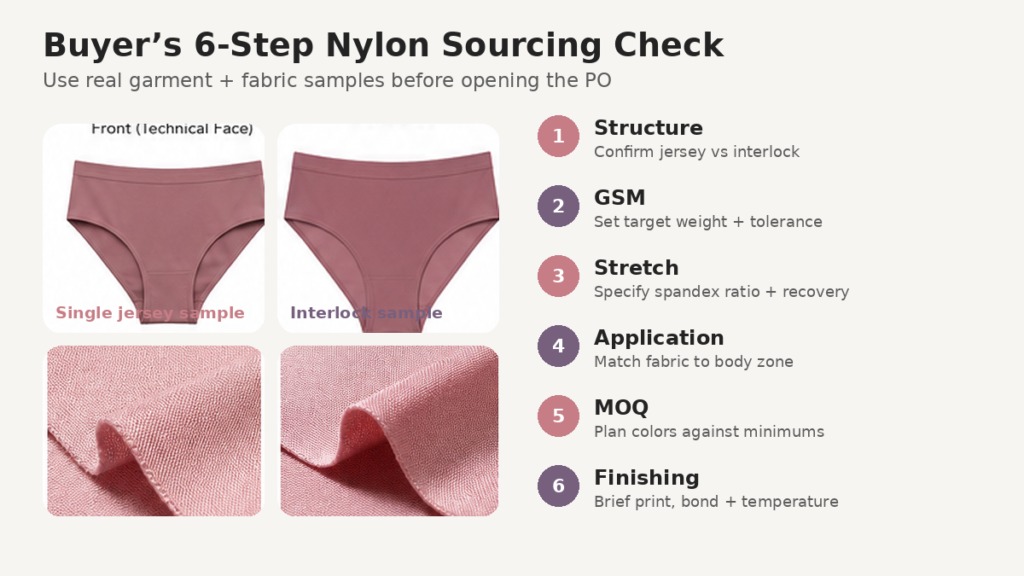
- Structure — confirm jersey vs interlock in writing, not by photo.
- GSM — write the target weight and tolerance on the order.
- Stretch — set the spandex ratio and recovery you'll accept.
- Application — map the fabric to the body zone and the garment type.
- MOQ — plan colors against 3000 pcs/color (innerwear) or 1000 pcs/color (shapewear).
- Finishing — brief print, bond, and temperature as a separate step.
On trust: we don't lean on outside approvals to prove quality. As the knitting factory based in China, we build credibility on quantified specs and on testing against the standard you name, run on our own production lines. For double-sided programs, we compare several interlock constructions and select the one with the best stretch and recovery to send you as reference swatches. Before we recommend a fabric for your style, we run fitting trials on the shortlisted cloth, so the handfeel and recovery hold up on a real body and not just on paper. You set the test; we return the raw data.
Ready to move? Request a quote — MOQ 3000 pcs/color (innerwear) / 1000 pcs/color (shapewear). Start at request a quote or talk to our team at contact.
FAQ
These are the questions B2B buyers ask most before they open a nylon fabric order.
Q1: Do you provide fabric swatches or color cards before I place a bulk order?
Most nylon knit mills offer a physical swatch set and a printed or digital color card on request, usually for a small handling fee or free above a certain inquiry value. Expect sample lead times that we confirm per inquiry for stock shades and custom-dyed lab dips. Ask the supplier to mark each swatch with its construction (jersey vs interlock), GSM, and composition so you can verify handfeel before committing to the bulk MOQ of 3000 pcs/color for underwear and bras or 1000 pcs/color for lingerie and shapewear.
Q2: How long does the first production order take compared with repeat orders?
First orders typically run longer than reorders because they include lab-dip approval, bulk knit setup, and often a pre-production strike-off. Plan for a longer window on a first order than on a repeat, though the exact gap shifts with peak season and dye-house load. To protect your calendar, confirm the critical path in writing and build buffer before any launch date. Note that the real production minimums stay fixed at 3000 pcs/color for underwear and bras and 1000 pcs/color for lingerie and shapewear regardless of lead time.
Q3: How can I make sure the factory doesn't substitute cheaper single-sided jersey for double-sided interlock?
Specify the construction in the purchase contract and on the packing list, then verify at incoming inspection. Tell them apart by the cut edge: interlock has no visible curl and its plies lock together, while jersey curls to the right on the face and left on the back. Weigh a known area to confirm true two-sided density, and request a cross-section photo or a third-party inspection before final payment. If the supplier resists written specs, treat it as a red flag before you commit the 3000 or 1000 pcs/color minimums.
Q4: Can you match a specific Pantone color for my nylon fabric?
Yes, most mills develop a lab dip against your Pantone reference and submit it for your approval before bulk dyeing. Expect a tight color tolerance under controlled lighting, and approve only under the same light source you will use for production checks. A lab-dip fee may apply or be waived above a committed volume. Judge the dip on nylon itself rather than a paper chip, since nylon depth and tone differ from cotton references, before locking your order to the MOQ stated in our Cost & MOQ section.
Q5: Do you keep nylon fabric in stock or produce it to order?
It depends on the mill. Commodity shades like black or nude are often held as greige or stock-dyed rolls with shorter turnaround, while custom colors and private constructions are knit to order. Made-to-order protects your exclusivity but fixes you to the full MOQ stated in our Cost & MOQ section for underwear and bras or lingerie and shapewear. Ask whether the supplier reserves greige inventory for you, since that can shorten reorder lead times without forcing you to hold finished stock.
Q6: What documents and roll details ship with my nylon fabric order?
Expect a commercial invoice, packing list, and a bill of lading or airway bill, plus roll-level labels showing construction, color, lot number, and meters per roll. Insist that each roll tag states single-sided jersey or double-sided interlock so warehouse staff cannot mix them. Some buyers also request a mill test report run against their own specification for colorfastness or pH, conducted by an independent lab. Align the document format with your broker before shipping to avoid customs or receiving delays.
Q7: Which knit structure should I pick for specific garment parts like waistbands or cup linings?
Go finer than the product category. Waistbands and straps need high rebound, so a spandex-rich single-sided jersey often suffices and saves cost. Cup linings and gussets want stability and no show-through, so double-sided interlock is the safer call. Side panels in seamless bodies benefit from the smooth, mark-free surface of interlock. Match the structure to the stress each part sees rather than the whole garment, then consolidate colors to hit the minimums stated in our Cost & MOQ section efficiently.
Final Thoughts
Partner with GOLDEN METRO, a factory-direct OEM/ODM underwear manufacturer based in China, with in-house knitting and garment production lines. From Bra & Bralette to Women's Undie, Sexy Lingerie, and Shapewear, we earn buyer trust through quantifiable specs and inspection to your specified standards, with friendly MOQs from 1000 pcs/color. Get a quote: https://underweargm.com/.