Terminology first: In this guide, a jelly bra means a complete wireless bra with shoulder straps, molded cups, side wings, an underband and a back or front closure. Flexible gel-like support strips—often called jelly strips—are positioned beneath the cups or along the sides to provide shaping and support without a rigid metal underwire. It does not mean a sticky bra, adhesive cup, nipple cover or backless invisible bra.
Why Construction Matters
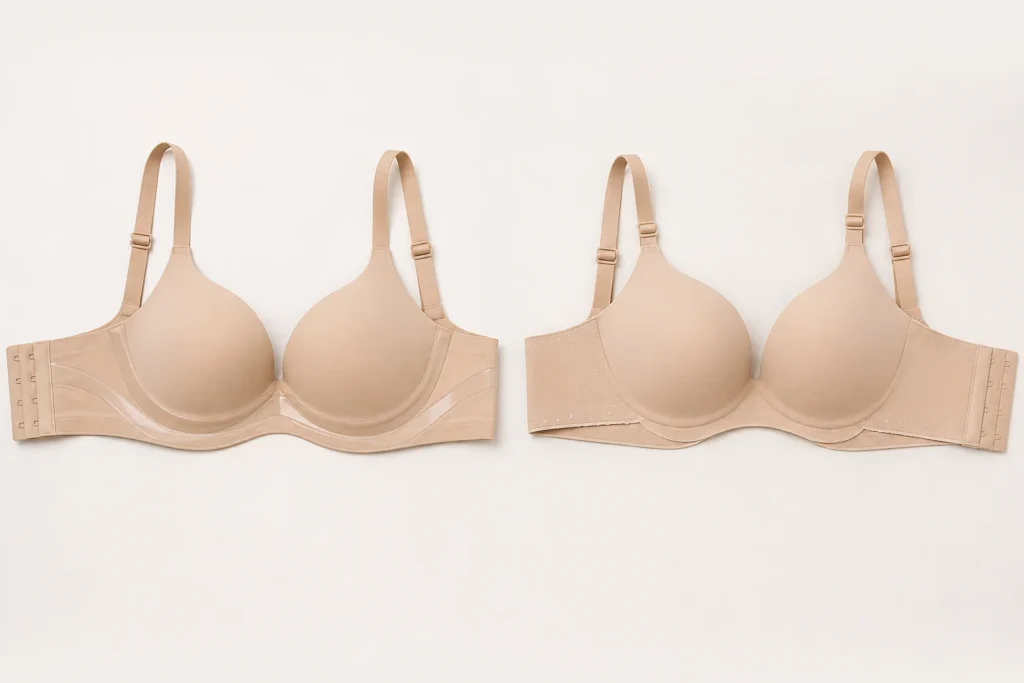
Two wireless bras can look nearly identical in a catalog image and perform very differently in bulk production. The difference is not whether one product is “sticky.” The real questions are how the bra creates support, how its layers and edges are joined, and how consistently those steps are controlled.
A jelly-strip bra uses a flexible support element within the garment. Depending on the approved design, the strip may follow the lower cup, center front, side support zone or a wider W-shaped path. It works together with the cup, fabric recovery, wing height, strap position and underband—not as a separate adhesive surface placed against the skin.
“Glued bra” is also a broad term. Bonding and lamination are normal lingerie construction methods, and a properly engineered bonded bra can perform well. The quality risk arises when a supplier relies on irregular glue dots, incomplete bonding or poorly controlled heat and pressure without a stable construction standard. That low-cost route can lead to uneven edges, local layer separation and inconsistent shape.
For B2B sourcing, compare the approved construction—not just the product name or front-view photo.
By Construction Method: Continuous Jelly Support vs Irregular Dot Gluing
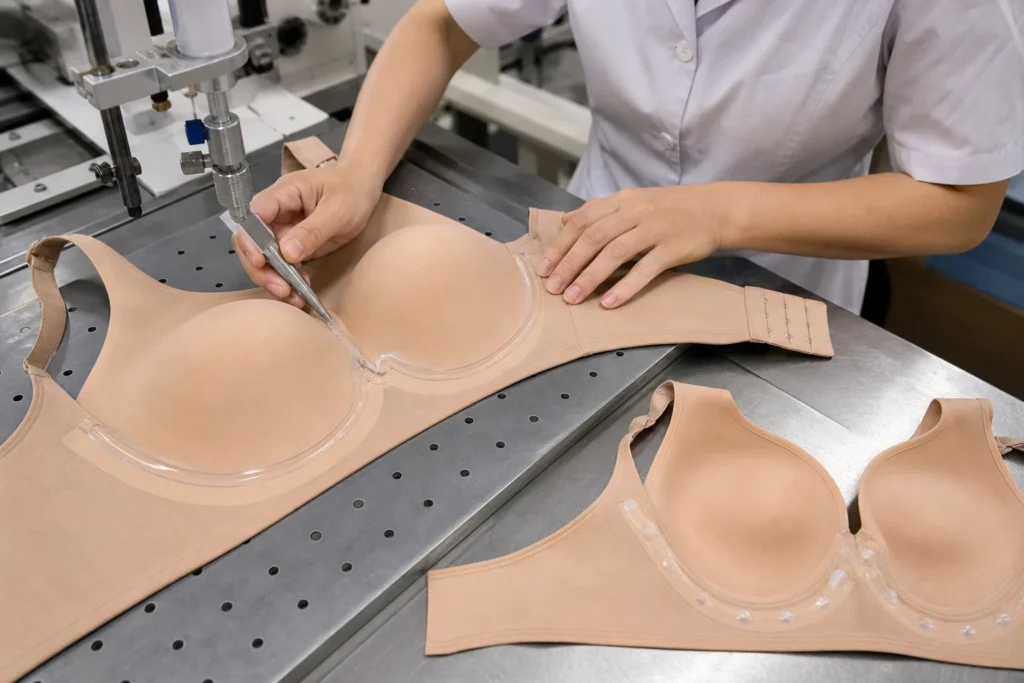
The jelly strip is a support component. Dot gluing is a joining method. They are not exact opposites, and a jelly bra may still include sewn, bonded or laminated areas in the same garment.
In a controlled jelly-bra construction, the flexible support strip is placed according to an approved position and shape. The fabric, molded cup, lining, edge method and joining process are selected to work with that support layout. Positioning matters: a strip that sits too low, too high or differently from side to side can change cup balance and wearing pressure.
In a low-cost dot-glued construction, adhesive may be applied only at scattered points between layers. If glue quantity, placement, surface preparation, heat, pressure or curing is inconsistent, one area may hold while another begins to lift. The defect may not be obvious in a single catalog sample.
Ask the supplier for inside-construction photos, an approved sample and several random units from the same lot. Confirm these points before bulk production:
- Jelly-strip position and symmetry
- Cup, wing and underband measurements
- Joining method used in each area
- Edge flatness and adhesive appearance
- Approved care instructions
- Any wash, flex or peel test method required for the order
By Edge Quality and Finish
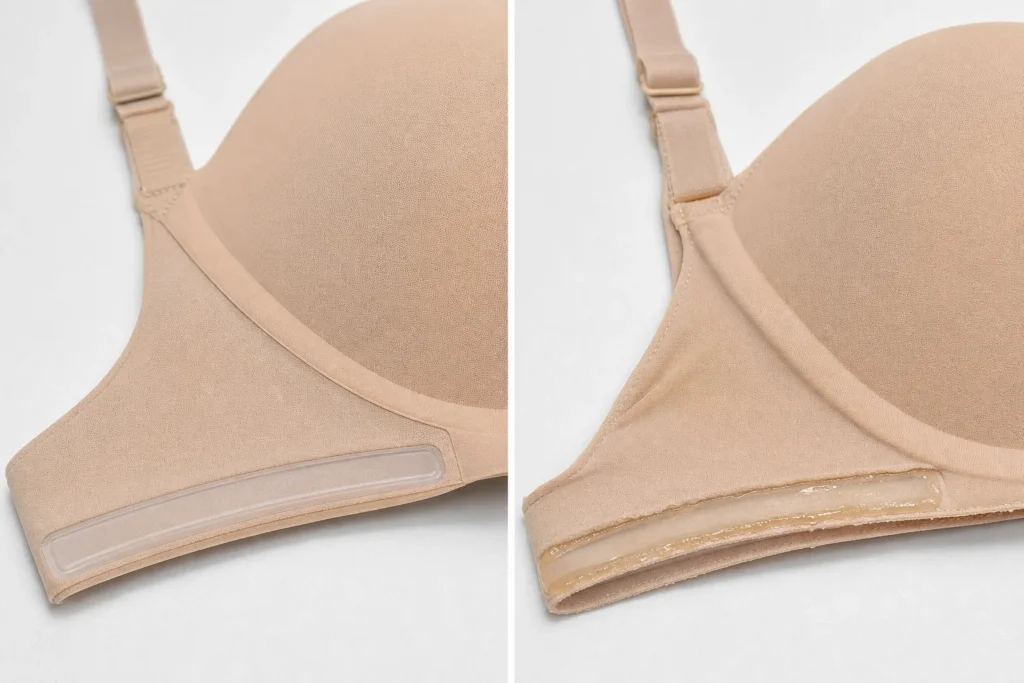
On a complete wireless bra, edge quality should be checked at the neckline, armhole, cup-to-wing transition, lower band, side wing and closure area. A clean edge should lie flat without visible adhesive overflow, waviness, lifting or distortion.
For a jelly-strip style, the support component must also finish cleanly before the edge or seam ending. If the strip ends in the wrong position, is too thick for the surrounding material or is not secured consistently, it may create a visible ridge or pressure point.
Dot-glued construction becomes risky when adhesive placement varies from one unit to another. The first sample may appear acceptable while later units show raised spots, incomplete contact or local edge lift.
When approving a sample, do not rely on one polished unit. Request close-up photos of several randomly selected bras from the same production stage. Compare left and right sides, then lay the garments flat to check whether the edges recover to the same shape.
By Bonding and Delamination Risk
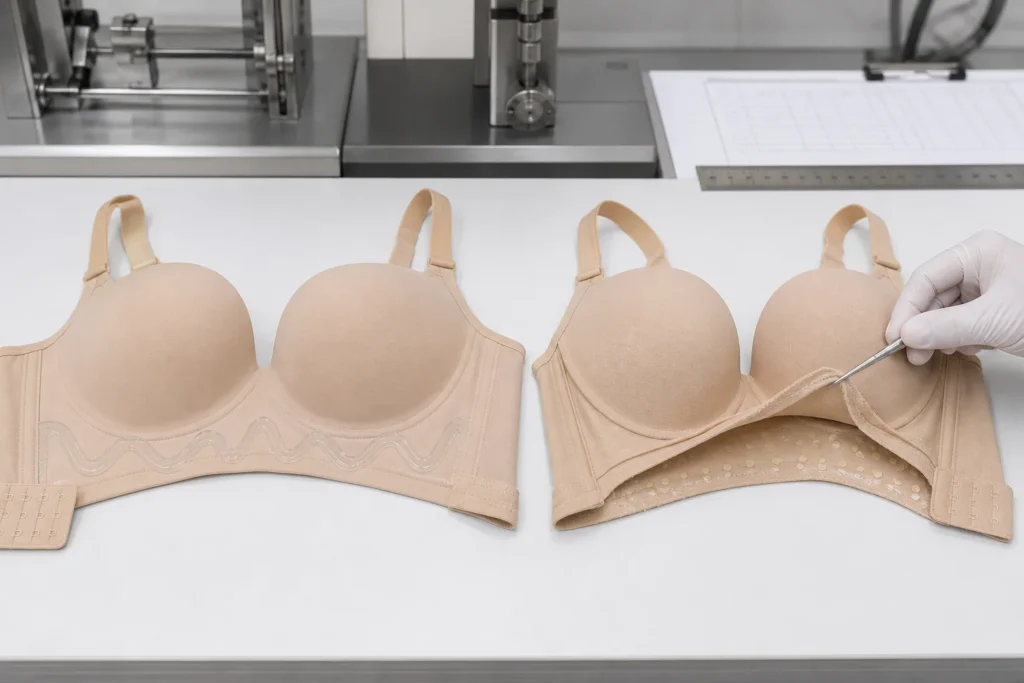
In this product category, “degluing” means separation between garment layers or between an approved support component and the surrounding construction. It does not mean the bra peeling away from the wearer’s skin.
Common warning signs include:
- Small bubbles or unbonded areas between layers
- Lifting at the lower band or side wing
- Adhesive marks or bleed-through on the fabric surface
- A support strip shifting away from its approved position
- Separation after repeated flexing or washing
- Different results between the left and right sides
Bond durability depends on the material combination, adhesive or film, surface preparation, process settings, joint design and care conditions. A product name alone cannot establish performance.
If wash, peel, flex, recovery or heat-aging tests matter to your market, agree on the method before the purchase order is finalized. The test sample size, cycle, temperature, detergent, drying method and acceptance criteria should be written into the order standard. This turns “strong bonding” from a vague promise into a checkable requirement.
By Size and Fit Consistency
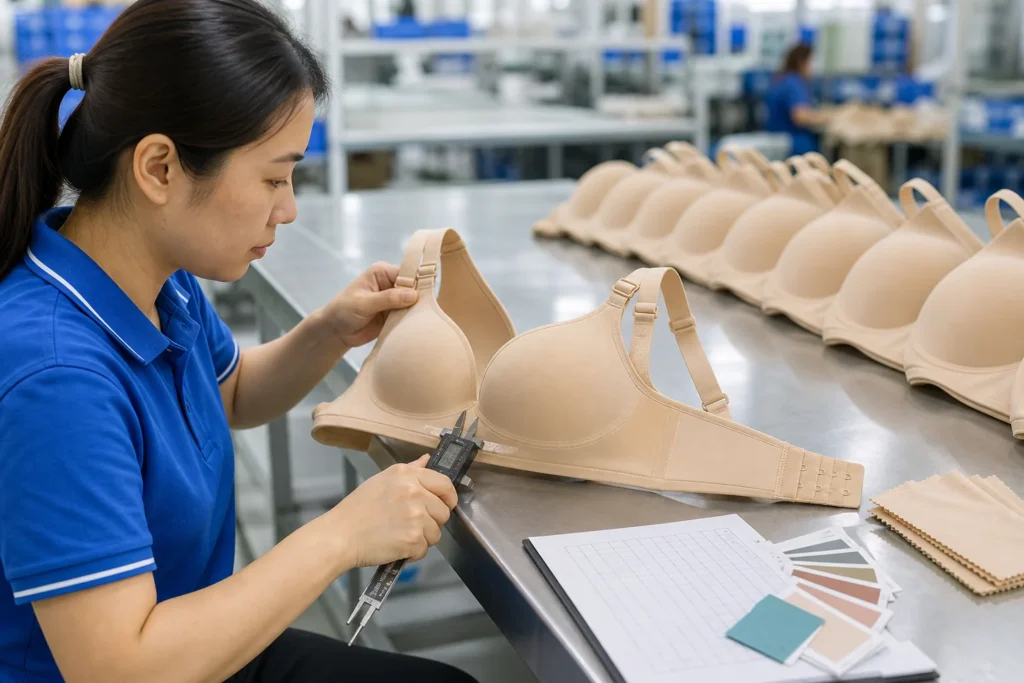
Support placement and garment measurements must remain consistent together. Even if the jelly strip itself is correct, a change in cup shape, wing depth, underband length, strap setting or fabric recovery can alter the fit.
For custom development, start with an approved base-size fitting sample. Where applicable, use a size set to check that cup coverage, support-strip position, pad placement, wing height and overall balance remain suitable across the proposed range.
For bulk inspection, compare random units with the approved measurement chart and pre-production sample. The useful checkpoints may include:
- Cup width, height and spacing
- Underband and wing measurements
- Jelly-strip position and left-right symmetry
- Strap position and adjustability
- Closure position
- Overall flat shape and recovery after handling
Sizing should be verified with agreed tolerances. Terms such as “true to size” or “one size fits most” are not a substitute for a measurement chart and fitting evidence.
By Durability and Care Performance
A jelly bra is an everyday garment, not a reusable sticky cup. Its durability should therefore be assessed through normal bra wear and care: flexing, stretching, washing, drying, material recovery and retention of the approved support layout.
A controlled construction keeps the support strip, cup, wing and edge working as one system. Poor bonding may first appear as a small lifted area, but repeated movement can enlarge that defect and change the garment’s shape.
Before making a durability claim, define the care method and test conditions. Hand washing, machine washing, water temperature, detergent and drying can produce different results. The published care label should match the materials and construction approved for that style.
For sample evaluation, photograph the same garment before and after the agreed test. Compare edge flatness, layer attachment, support-strip position, cup shape, measurements and fabric recovery. Keep the tested sample as part of the order record.
By Price and Total Cost of Ownership
Dot-glued construction may reduce the initial quotation because it uses less controlled joining work. That saving should be evaluated against the complete landed and after-sales cost.
A useful total-cost comparison includes:
- Unit price
- Sampling and revision cost
- Inspection or testing cost
- Expected defect allowance based on your own evidence
- Rework, replacement and return handling
- Customer-service time
- Repeat-order consistency
- Brand and retailer requirements
Do not use an assumed return percentage unless it comes from your own sales data or a documented trial. A practical approach is to run a controlled sample order, inspect random units and record the defect types before committing to a larger program.
The cheapest quotation is not automatically the lowest-cost product. The better choice is the construction that meets the target market’s fit, appearance and durability requirements at an acceptable total cost.
Key Differences at a Glance
| Dimension | Controlled Jelly-Strip Wireless Bra | Low-Control Dot-Glued Bra |
|---|---|---|
| Product format | Complete wireless bra with straps, cups, wings, underband and closure | Complete bra; product format may look similar from the outside |
| Support system | Flexible jelly strip positioned beneath the cups and/or along side-support zones | May have limited structural support or depend mainly on fabric, cup and band |
| Joining method | May combine controlled bonding, lamination and sewing according to the approved style | Relies heavily on scattered adhesive points with limited process control |
| Edge finish | Designed to remain flat and consistent when materials and settings are approved | Greater risk of waviness, overflow, lifting or incomplete attachment |
| Fit consistency | Support position is checked together with cup, wing, band and size measurements | Irregular joining can distort shape or vary between units |
| Durability | Evaluated through agreed flex, wash and recovery checks | Local separation may develop where adhesive contact is incomplete |
| Price | May require more development and process control | May offer a lower initial unit quote |
| Best sourcing basis | Approved sample, BOM, measurement chart, support layout and QC plan | Use only after sample testing proves the construction meets requirements |
Which Construction Should You Source for Your Market?
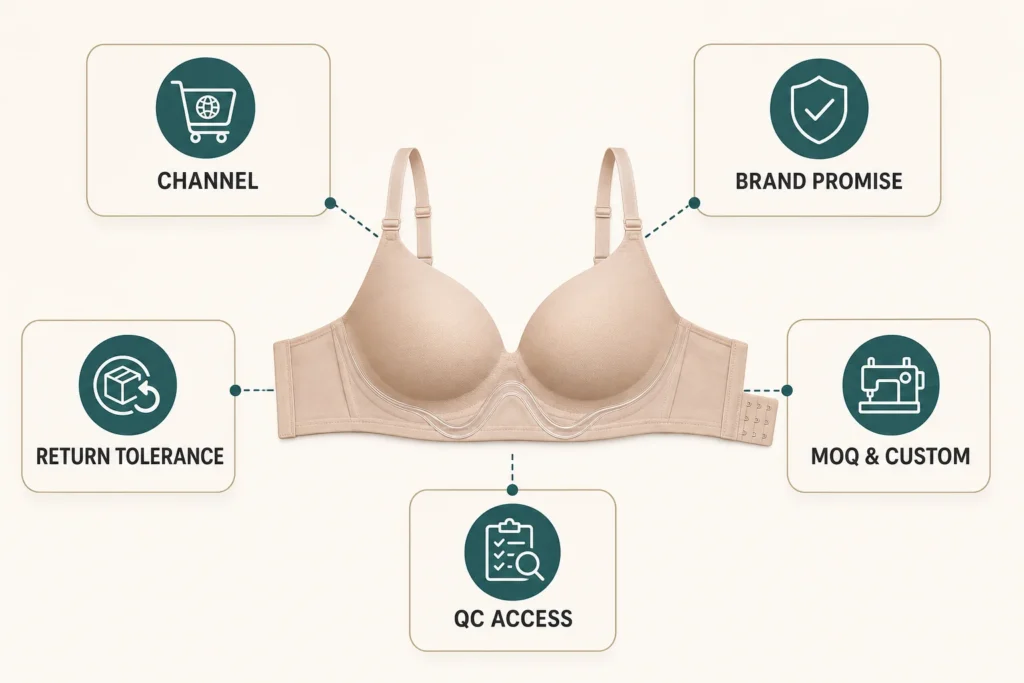
Choose the construction according to the selling channel, fit promise and evidence required—not according to the category label alone.
1. End-Use Channel
For everyday comfort, T-shirt, seamless, fuller-coverage or extended-size programs, support distribution and wearing comfort are central to the product brief. A jelly-strip construction can be reviewed as an alternative to rigid underwire, but the correct strip layout depends on the approved fit and size range.
For an entry-price program, a simpler bonded construction may be considered. It still needs to pass the same agreed appearance, measurement and durability checks.
2. Brand Promise
If your brand promises smooth edges, wireless support and repeat-order consistency, those points must become measurable development standards. Send the reference garment, target fit, size range and current customer complaints rather than asking only for “better quality.”
3. Return Tolerance
Use your own return reasons to set priorities. Cup gaping, band ride-up, strap slip, side spillage, edge lifting and layer separation require different product changes. A construction decision should address the actual complaint rather than add a jelly strip for marketing value alone.
4. MOQ and Customization
Selected ready-stock styles may start from 200 pieces, subject to current style, color, size, ratio, branding, packing and quantity availability.
For a custom program, the baseline minimum is 2,000 pieces per color per style. The final route depends on the support layout, cup and pad system, materials, size range, color plan, branding, packaging and required testing.
5. QC Access
Ask whether the supplier can work from an approved pre-production standard and provide relevant production records, sample comparisons or inspection access. If third-party inspection or order-specific testing is required, agree on the scope and responsible party before production.
Quality Control for Bulk Jelly-Bra Orders
Golden Metro uses the approved product specification as the inspection reference. Depending on the style, the control process may include four practical stages:
1. Pre-Production Material Check
Compare the proposed body fabric, lining, cup, pad, support component, elastic, closure, labels and color reference with the approved order information. A substitute material should be submitted for review rather than treated as automatically equivalent.
2. In-Process Construction Check
Review pattern placement, cutting, molding, jelly-strip position, sewing, bonding or lamination according to the confirmed production route. Early correction prevents a repeated construction error from moving through the full batch.
3. Finished-Garment and Measurement Check
Compare random finished units with the approved measurement chart and sample. Inspect shape, left-right balance, support position, edge appearance, attachment, visible adhesive marks, components and workmanship.
4. Packing-Detail Check
Verify size and color assortment, labels, barcodes, folding, individual packing and carton information against the order instructions.
If your program requires a specific AQL, laboratory test, wash test or retailer protocol, provide the method and acceptance requirements during order review. These conditions should not be assumed from the words “jelly bra” or “wireless bra.”
FAQ
What is a jelly bra?
In this guide, a jelly bra is a complete wireless bra that uses flexible gel-like support strips beneath the cups or in side-support zones instead of a rigid metal underwire. It has the normal components of a bra, such as shoulder straps, cups, wings, an underband and a closure. It is not a sticky or backless adhesive cup.
Is a jelly strip the same as an underwire?
No. A jelly strip is flexible and works together with the fabric, cup, wing, band and strap layout. A rigid underwire has a fixed wire shape and sits in a wire channel. The two constructions distribute support differently, so one pattern should not be converted into the other without fitting and measurement review.
Are all glued or bonded bras low quality?
No. Bonding and lamination are established garment-construction methods. Quality depends on compatible materials, joint design, adhesive or film selection, surface preparation, process settings and inspection. The risk described in this guide is irregular dot gluing with insufficient process control—not every bonded bra.
How can I check whether the jelly-strip position is correct?
Compare the inside and outside of the sample with the approved support-layout drawing or physical reference. Check left-right symmetry, distance from the cup edge, ending position at the center and sides, and how the strip behaves during fitting. The position should also be checked across the intended size range where applicable.
What tests should I request for a bonded jelly bra?
Choose tests according to the material, construction, care label and market requirement. These may include flexing, wash, peel, recovery, dimensional-stability, colorfastness or component checks. Agree on the method, sample size, cycles, conditions, acceptance criteria and responsible party before the order is placed.
Can I private-label a jelly bra?
Yes. A custom program can review the support layout, cup and pad system, body material, color, size range, straps, closure, logo, labels and packaging. Custom production starts from 2,000 pieces per color per style. Development feasibility and any material or component minimums are confirmed after the product brief is reviewed.
What information is needed for a useful quotation?
Send a tech pack, clear reference images or an original sample, plus the target market, size range, quantity by color, target price position, support and pad requirements, fabric direction, branding, packaging and delivery destination. Include inside-construction photos when available; a front-view image alone cannot define the joining method or support layout.
How do you control repeat-order consistency?
Repeat orders should be reviewed against the approved bill of materials, measurement chart, color reference, sample, branding and packing standard. Current material availability must also be confirmed. Any component, material or process change that may affect the approved product should be reviewed before bulk production.
Final Thoughts
The useful comparison is not “sticky jelly bra versus ordinary bra.” It is a complete wireless bra with a controlled jelly-support system versus a bra whose layers depend on poorly controlled dot gluing.
For buyers, the safest sourcing decision begins with a clear product brief and ends with an approved production standard. Review the support layout, cup and wing construction, measurement chart, joining method, care conditions and QC plan together. This gives the supplier something specific to manufacture and gives your inspection team something specific to verify.
Golden Metro supports ready-stock, OEM, ODM and private-label lingerie programs. To review a jelly-bra project, send your reference style or tech pack, target market, size range, quantity by color, price position, branding, packing requirements and any current fit or quality complaint.
Contact: Wendy
Email: wendy@goldenmetro.cn
Phone / WhatsApp: +86 135 3689 0620
Website: underweargm.com
CTA: Request a Jelly Bra Feasibility Review and Quote